How to do it safely, slowly, and in a way that actually works. Good introductions are not about luck. They are about reducing pressure, protecting choice, and building a relationship that can hold up in real life.
You bring your new dog home. Your house already has animals in it. Maybe another dog. Maybe a cat. Maybe both. And now there is this quiet pressure sitting in the air.
You are wondering when to introduce them, how to do it, and whether you are about to make a mistake you cannot undo. Because you have probably heard two completely opposite pieces of advice: let them meet and work it out, or keep them apart forever. Neither of those is right.
Good introductions are not about gambling. They are not about rushing, and they are not about pretending every animal will figure it out if you just stand back. They are about understanding how animals process each other, and then building that relationship in a way that does not create unnecessary pressure.
The short version: the goal at the beginning is not instant friendship. The goal is calm awareness without pressure. That is what gives you the best chance at long-term peace.
Not a single meeting. A shared life in one home.
Too much pressure, too much access, and too little structure too soon.
Neutrality. Calm. The ability to notice each other and move on.
It helps to stop thinking of this as one event. You are not just introducing two animals. You are building a relationship they are going to live inside of every day. And the very beginning of that relationship matters more than people realize.
Your new dog is not coming in neutral. They are carrying stress, confusion, and the strain of a major transition. Your existing animals are not neutral either. They are dealing with a stranger in their space, around their smells, their routines, their resting spots, and their sense of safety.
So before anything obvious even happens, both sides are already asking the same question: is this safe? Everything you do in the first few days answers that question for them.
Most failed introductions do not begin with a “bad dog.” They begin with too much intensity too early. The new dog comes home, everyone is alert, and someone says, “Let’s just see how they do.” That one sentence has started a lot of unnecessary problems.
Even when a first meeting does not explode, animals are still forming opinions. If the first interaction feels tight, overwhelming, or chaotic, that feeling does not vanish just because nobody bit anyone. It becomes part of the relationship.
This is why first impressions matter. Not because they must be magical, but because they should be low-pressure enough that nobody feels they need to defend themselves, control the situation, or survive it.
Do not ask, “When can they meet?” Ask, “How do I make this feel safe and unsurprising for both sides?” That question leads to much better choices.
This is one of the most common points of confusion, so it deserves to be very clear. You do not start by putting dogs in crates next to each other. You do not start by putting one behind a baby gate so they can stare face-to-face. And you absolutely do not put one dog in a crate or pen while the other roams loose and sniffs around them.
Those setups feel controlled to humans, but to animals they often feel like pressure without escape. Dogs regulate social interactions through movement. They approach, pause, arc away, create distance, and decide how much contact they want. That movement is not extra. It is how they stay out of conflict.
When you trap them in a crate, place them nose-to-nose behind a barrier, or confine one while the other is free, you remove their primary way of staying safe. Now they can see each other, smell each other, and react to each other, but they cannot actually resolve the interaction or leave it.
That is how curiosity becomes pressure. That is how alertness becomes frustration. That is how a dog starts to associate the other animal with being trapped, crowded, or unable to breathe mentally.
The “one loose, one confined” setup is especially unfair. The loose animal has freedom, movement, and social control. The confined animal has none. Even a friendly dog can become overwhelming in that situation simply by hovering, staring, pacing near the crate, or repeatedly coming back. The confined dog does not learn, “This other dog is safe.” They learn, “This other dog approaches me and I cannot get away.”
That sticks. And once that feeling becomes part of the relationship, every next step is harder.
At the beginning, the goal is not direct interaction. The goal is for both sides to settle into the reality that another animal exists in the home without feeling pushed into a social decision they are not ready to make.
That means separation first. Not punishment. Not exile. Just clean, calm, structured separation. Separate rooms. Separate resting areas. Separate feeding. Separate time to decompress.
This gives the new dog a chance to come down from the transition and gives your resident animals a chance to adjust without feeling immediately invaded. The house becomes less intense before the relationship becomes more direct.
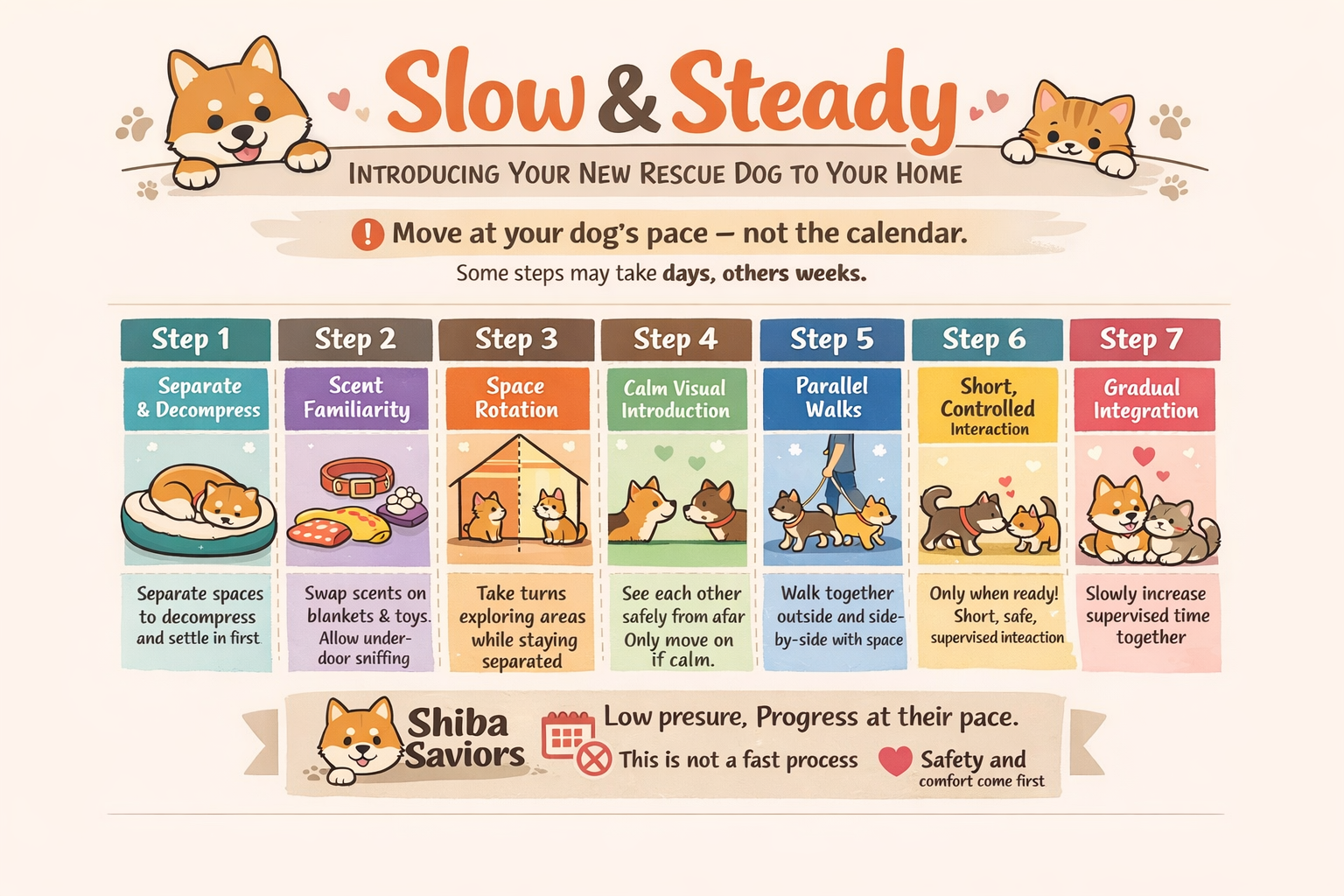
This is a guide, not a schedule. Some dogs move through steps in days. Others take weeks. What matters is calm behavior before moving forward.
Before animals are comfortable interacting, they become comfortable being aware of each other. That awareness does not have to be direct. In fact, it often develops better when it is not.
Shared scent helps. Rotating spaces can help. Letting each animal experience the other’s presence in a low-pressure way helps. This stage feels uneventful to people, which is why they tend to rush through it. But uneventful is exactly the point. Nothing dramatic should be happening yet.
You are building familiarity without confrontation. You are teaching both sides that the existence of the other animal does not automatically mean pressure, conflict, or forced contact.
One of the hardest things for dogs is a direct, stationary social setup. Face-to-face stillness carries pressure. There is nowhere for the energy to go. There is nowhere for tension to release.
Movement changes that. When dogs move in the same direction with space between them, the social pressure drops. Their bodies have something useful to do. Their focus is not trapped. They can process the other dog while also staying oriented to the world around them.
This is why parallel walking is so powerful. It allows shared experience without forcing contact. It creates a neutral pattern instead of a confrontation.
By the time you allow a more direct interaction, it should not feel like a dramatic event. That is a good sign. The best first interactions are often almost boring. A brief sniff. A pause. A step away. A reset.
You are not looking for instant play, instant closeness, or some big emotional moment that proves they are going to be best friends. You are looking for animals who can exist near each other without tension taking over.
Short, calm, repeatable experiences matter more than one long interaction that goes on too long and leaves everyone overloaded. End earlier than you think you need to. Leave something in the tank.
Cats and dogs do not read each other the same way. A dog may see motion and feel curiosity, excitement, or prey drive. A cat may experience that same attention as pressure or danger. That mismatch is where a lot of avoidable problems begin.
The cat must have control over space. Not symbolic control. Real control. The ability to leave, climb, hide, and fully disengage. The dog should not have free access to the cat early on, and the cat should never be cornered for the sake of an introduction.
What you are watching for is not whether the dog notices the cat. That part is normal. What matters is whether the dog can notice the cat and then return to themselves. Can they disengage? Can they stay responsive? Can they exist without escalating? That is what you build on.
Shibas are not wired like every other dog, and this matters in multi-pet homes. They are fast, quiet, independent, and often very capable of making decisions without checking in first. They can also have a stronger prey drive than people expect, especially in new, stimulating, or high-arousal environments.
That does not mean they cannot live successfully with other animals. Many absolutely can. It means you should move slower than your optimism wants to move. Calm at first glance is not the same thing as true reliability. You build trust through repetition, structure, and management, not by assuming the absence of drama means you are done.
With Shibas especially: do not confuse “nothing happened” with “the relationship is safe now.” Stay thoughtful. Stay structured. Earn that confidence.
Success is not always friendship. Sometimes you get that. Sometimes animals genuinely adore each other. But more often, success looks quieter.
It looks like animals who can share space without needing to control each other. It looks like a dog who can walk past the cat without locking on. It looks like another dog resting in the same room without guarding, posturing, or constantly monitoring. It looks like neutrality becoming normal.
That is not a lesser outcome. That is a stable household. And stability is what protects everyone.
There is no perfect cinematic moment where introductions are suddenly finished. There is just a process that either builds trust or builds tension.
You do not rush that process. You do not trap animals and call it control. You do not create pressure and hope it teaches calm. You protect space first. You let awareness develop before interaction. And you keep both animals’ ability to disengage intact until they no longer need it.
Because in the end, you are not just staging a meeting. You are building a shared life. And the way you start it shapes everything that comes after.